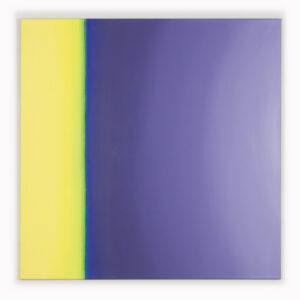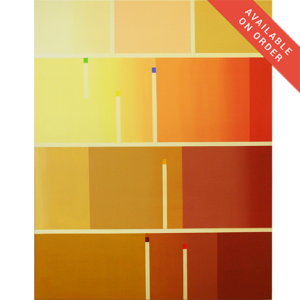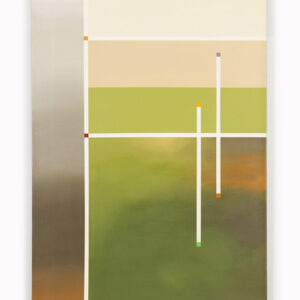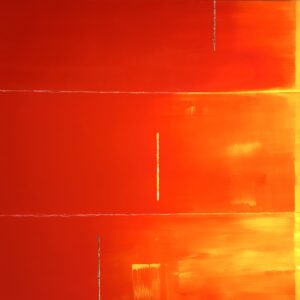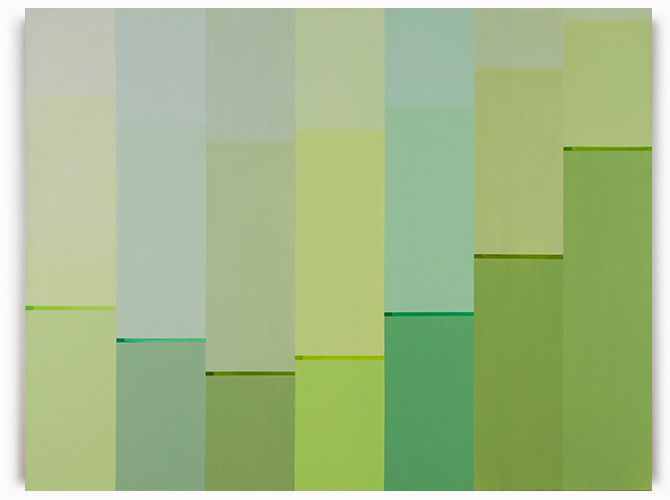
The Places cycle is grounded in the idea of orientation — not as a visual concept, but as a spatial experience.
Developed over extended periods in my studio in Bali, these works are informed by the observation of rice field landscapes, where horizontal terraces and subtle vertical interruptions create a naturally ordered yet continuously shifting environment shaped by light, water, and time.
Rather than representing a landscape, the works translate these conditions into perceptual fields.
I refer to them as Klim(art) zones — atmospheric zones defined by colour, light, and presence rather than fixed form. Gradual transitions between horizontal bands of colour create a sense of continuity and calm, allowing the eye to move without interruption. The palette — earthy reds, saffron tones, and nuanced greens — carries the memory of natural materials and changing environmental conditions.
Within architectural contexts, these works function as stabilising visual anchors. Their structure provides orientation, while their soft chromatic transitions reduce visual tension and support a sustained, quiet engagement with the space.
Rather than acting as focal objects, they integrate into the spatial logic of a setting, subtly influencing how a space is perceived, experienced, and remembered.
The works create a sense of place — a visual and perceptual point of return within the built environment. They offer not only an image to look at, but a condition to remain within: a home, a base, a belonging.